MIT Free Online Courses 2026: Learn from MIT for Free
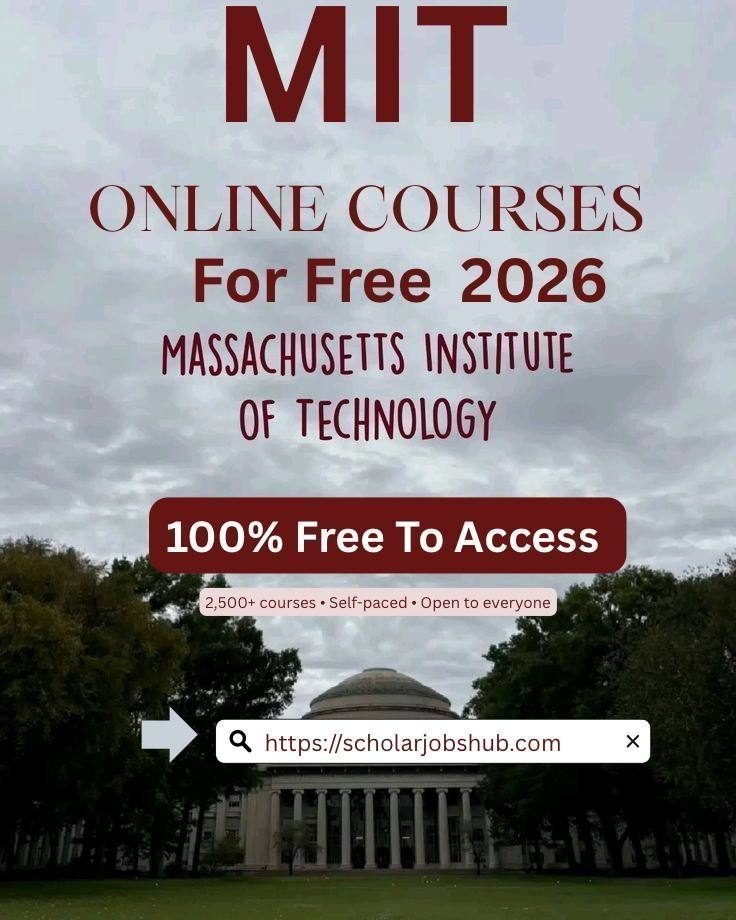
Are you looking to learn new skills, improve your career prospects, or study advanced subjects without paying university tuition fees? The MIT Free Online Courses 2026 give learners around the world access to educational resources from the Massachusetts Institute of Technology (MIT), one of the world's best-known institutions for science, technology, engineering, and research.
Through MIT OpenCourseWare (OCW), learners can explore more than 2,500 MIT course collections covering computer science, artificial intelligence, engineering, mathematics, business, economics, biology, and the humanities. The platform provides free learning materials, including lecture notes, assignments, reading lists, examinations, and video lectures for many courses. No application, registration, or formal admission is required to access MIT OpenCourseWare materials.
MIT also offers structured online courses through MITx and related learning platforms. These courses provide a more interactive learning experience, and some offer an optional certificate of completion for a fee. This distinction is important: MIT OpenCourseWare is free but does not award certificates, while selected MITx courses offer certificates under their own terms.
Whether you are a student, graduate, working professional, entrepreneur, or lifelong learner, MIT's online learning resources can help you build knowledge at your own pace without relocating to the United States.
In this guide, ScholarJobs Hub explains the available subjects, benefits, eligibility requirements, differences between free course access and paid certificates, and how to start learning through MIT's official platforms.
MIT Free Online Courses 2026: Overview
Institution: Massachusetts Institute of Technology (MIT)
Country: United States
Learning Mode: Online
Main Platform: MIT OpenCourseWare
Available Subjects: Computer science, engineering, mathematics, business, science, humanities, and more
Course Materials: Free through MIT OpenCourseWare
Registration: Not required for MIT OpenCourseWare
Application Fee: None for accessing MIT OpenCourseWare materials
Deadline: No fixed deadline for MIT OpenCourseWare materials
Learning Schedule: Self-paced for MIT OpenCourseWare; individual MITx courses may have schedules and deadlines
Certificate: Not available through MIT OpenCourseWare; optional paid certificates are available for selected MITx courses
Important: These are open online learning opportunities, not a scholarship or admission programme for an MIT degree. Accessing free course materials does not enrol you as an MIT student or provide university credits.
About MIT OpenCourseWare
MIT OpenCourseWare is an initiative that makes educational materials from MIT courses available to the public for free.
The platform allows learners to access course content from across MIT's curriculum, ranging from introductory undergraduate subjects to advanced graduate-level material. Depending on the course, resources may include lecture notes, syllabuses, assignments, examinations, reading lists, video lectures, and other learning materials.
One of the biggest advantages of MIT OpenCourseWare is its flexibility. You can study a complete course in sequence, concentrate on a particular topic, or use the resources to supplement your existing education.
There is no formal application process, no enrolment requirement, and no fixed start or end date for using the materials. You can browse the courses and begin learning whenever you are ready.
MIT OpenCourseWare also makes many materials available for download, allowing learners to study offline where the relevant files permit it.
List of MIT Free Online Course Subjects
MIT OpenCourseWare covers a wide range of academic disciplines. Learners can choose courses based on their interests, educational background, or professional goals.
The following are some of the major subject areas available through the platform.
1. Computer Science and Artificial Intelligence
MIT provides extensive learning resources in computing and technology. Depending on the course, you can study programming, algorithms, data structures, artificial intelligence, computer systems, software development, and related topics.
These resources may be useful for learners pursuing careers in software engineering, data science, machine learning, and other technology fields.
2. Aeronautics and Astronautics
Explore concepts related to aircraft, spacecraft, aerospace engineering, flight mechanics, propulsion, and space systems.
This subject area is relevant to learners interested in aviation, aerospace technology, and engineering research.
3. Mathematics and Statistics
MIT offers mathematics resources covering topics such as calculus, linear algebra, differential equations, probability, statistics, and mathematical modelling.
These subjects are particularly useful for students in engineering, computer science, economics, data science, and other quantitative disciplines.
4. Electrical Engineering and Electronics
Learners can study electrical circuits, signal processing, electronics, communication systems, control systems, and other engineering subjects.
The materials can help students strengthen their theoretical understanding and prepare for more advanced technical courses.
5. Mechanical Engineering
Mechanical engineering resources cover areas such as dynamics, mechanics, materials, design, manufacturing, thermodynamics, and engineering systems.
They may be suitable for learners who want to develop a stronger foundation in mechanical design and industrial technology.
6. Biological Engineering and Biology
MIT provides courses and learning materials in biology, genetics, biotechnology, biological systems, and related scientific fields.
These resources can support students interested in life sciences, biotechnology, biomedical research, and advanced scientific study.
7. Chemical Engineering and Chemistry
Courses in these areas may cover chemical processes, reaction engineering, thermodynamics, materials, molecular science, and industrial applications of chemistry.
They are particularly relevant to students studying chemistry, chemical engineering, materials science, and related disciplines.
8. Economics and Business Management
MIT's resources also include economics, finance-related topics, management, operations, entrepreneurship, and business decision-making.
Learners can explore subjects that support careers in business analysis, management, economics, operations, and entrepreneurship.
9. Physics and Nuclear Science
Physics courses cover foundational and advanced topics, including mechanics, electromagnetism, quantum physics, waves, and other scientific principles.
Additional resources address nuclear science and engineering, depending on the course collection.
10. Earth, Atmospheric, and Environmental Sciences
These learning materials explore the Earth system, environmental changes, atmospheric science, climate, and planetary processes.
They may be valuable for students interested in sustainability, environmental research, earth sciences, and climate-related fields.
11. Architecture and Urban Planning
MIT offers learning resources covering architecture, city planning, urban studies, design, and the built environment.
These subjects can help learners understand how cities, buildings, and infrastructure are planned and developed.
12. Humanities, Arts, and Social Sciences
MIT's academic resources are not limited to science and technology. Learners can also explore anthropology, history, linguistics, philosophy, literature, political science, music, theatre arts, and comparative media studies.
This broad range makes the platform useful for people with interests beyond technical disciplines.
Explore the Full MIT Course Catalogue
The subjects listed above are only a selection of the available areas. Course availability, materials, and levels vary.
Browse the MIT OpenCourseWare course catalogue to find resources that match your interests.
Benefits of MIT Free Online Courses 2026
MIT's open learning resources offer several advantages for students, professionals, and independent learners.
1. Access Educational Materials from MIT for Free
MIT OpenCourseWare makes course materials publicly available without tuition fees, formal admission, or enrolment requirements.
This makes it possible to explore topics taught at a leading university without the cost of attending a degree programme.
2. Study at Your Own Pace
There is no fixed timetable for MIT OpenCourseWare materials. You can study during your free time, revisit difficult topics, and progress according to your own schedule.
This flexibility is useful for people balancing their studies with employment, business, family responsibilities, or other commitments.
3. Learn Across Multiple Disciplines
The platform covers science, technology, business, engineering, mathematics, and the humanities.
You can focus on one discipline or explore subjects from different fields to broaden your understanding and develop complementary skills.
4. Strengthen Your Academic Knowledge
Students can use MIT materials to supplement their university courses, review difficult concepts, practise with assignments, or prepare for more advanced study.
Working through a syllabus and completing the associated exercises can also help identify knowledge gaps.
5. Develop Career-Relevant Skills
Depending on the courses you study, you may improve your understanding of programming, mathematical analysis, engineering concepts, business strategy, economics, or other useful subjects.
The benefit comes from actively engaging with the materials and applying what you learn, rather than simply opening a course page.
6. Access Course Materials Without Relocating
You can use MIT OpenCourseWare from Nigeria or almost anywhere else in the world with a suitable internet connection.
There is no need to travel to the United States, pay international tuition, or obtain a student visa simply to access open course materials.
7. Download Materials for Independent Study
Many course resources can be downloaded for personal study, subject to the relevant content licence.
This can be helpful for learners who prefer offline study or want to keep notes and materials available for later revision.
8. Explore More Structured Courses Through MITx
For learners who prefer a more organised online learning experience, selected MITx courses include interactive exercises, assessments, videos, readings, and discussion features.
Some also offer optional certificates of completion for a fee. Check the individual course page for available learning options, costs, and requirements.
Are MIT Free Online Courses Suitable for Beginners?
Yes, many MIT course materials can be useful for beginners, but not every course is designed for learners with no previous knowledge.
Introductory courses may explain foundational concepts and guide learners through the material from the beginning. More advanced courses may assume prior knowledge of mathematics, programming, scientific principles, or another subject.
Before starting a course, review its syllabus, recommended prerequisites, and learning objectives.
For example, someone new to programming should consider an introductory computer science course before attempting advanced algorithms or machine learning materials. Similarly, a learner studying advanced calculus should first check whether the course assumes knowledge of algebra, functions, and introductory calculus.
Choosing the correct starting level can make the learning experience more productive.
Eligibility Criteria for MIT Free Online Courses 2026
One of the main advantages of MIT OpenCourseWare is that it does not operate like a conventional university admissions programme.
1. Open to Learners Worldwide
MIT OpenCourseWare materials can generally be accessed from anywhere in the world. Learners in Nigeria and other countries can browse available resources online.
2. No Formal Academic Qualification Required for Access
You do not need a bachelor's degree, secondary school certificate, or previous university admission simply to access MIT OpenCourseWare materials.
However, individual courses may recommend prior academic knowledge to help learners understand the material.
3. No Formal Application or Enrolment
You do not need to submit an application, wait for an admission decision, or enrol in MIT OpenCourseWare.
You can open the website, select a course, and start studying immediately.
4. No Age Limit for General Access
MIT OpenCourseWare does not impose a general age limit for browsing its course materials. Learners of different ages can explore subjects according to their interests and abilities.
5. Internet Access and Personal Commitment
A suitable internet connection is needed to browse or download the resources. Some learners may also need a computer or other device capable of opening course files and watching video lectures.
The main commitment is the time and effort required to study the material and practise the concepts.
Note: These access conditions apply to MIT OpenCourseWare. Individual MITx courses may have separate registration requirements, schedules, technical requirements, or restrictions.
Do MIT Free Online Courses Offer Certificates?
This is one of the most important questions to understand before choosing a course.
MIT OpenCourseWare does not provide certificates, academic credits, or degrees for completing its materials. You can study the resources for free, but you should not expect an official certificate at the end.
However, MIT offers other online learning options, including selected MITx courses, that may provide certificates of completion for a fee.
MIT OpenCourseWare vs MITx Online
| Feature | MIT OpenCourseWare | MITx Online |
|---|---|---|
| Access to learning materials | Free | Many courses offer free learning access |
| Formal enrolment | Not required | Usually required |
| Registration | Not required for OCW | Account required |
| Learning format | Self-guided course materials | More structured online course experience |
| Assessments | Vary by course; materials may include assignments and exams | May include interactive and graded assessments |
| Certificate | Not offered | Available for selected courses, usually for a fee |
| Fixed deadlines | No general start or end dates | Depends on the course |
| Instructor or peer interaction | No general course discussion or live teaching support | Some courses offer discussion and learning interaction |
MIT's official guidance on OpenCourseWare explains that OCW does not award certificates. The MITx Online website provides details about structured courses and the options available to learners.
If your primary goal is to gain an official certificate, examine the individual MITx course details before enrolling and check the certificate fee and completion requirements.
How to Access MIT Free Online Courses 2026
You do not need to apply for admission to access MIT OpenCourseWare. Follow these simple steps to start learning.
Step 1: Visit the Official MIT OpenCourseWare Website
Go to the official MIT OpenCourseWare website by clicking the APPLY NOW button to access MIT's free course materials.
Step 2: Explore the Course Catalogue
Browse the subjects or use the search function to find courses related to your interests, career plans, or academic needs.
You can search for topics such as computer science, artificial intelligence, engineering, mathematics, economics, or management.
Step 3: Choose a Suitable Course
Open the course page and review the syllabus, course objectives, topics, and recommended prerequisites.
Choose a course that matches your current knowledge and gives you an appropriate level of challenge.
Step 4: Open the Course Materials
Depending on the course, you may find lecture notes, reading lists, assignments, examinations, video lectures, or other resources.
There is no need to create an MIT OpenCourseWare account to access these materials.
Step 5: Follow the Course Syllabus
Use the syllabus to organise your study schedule. Work through the topics in sequence, review the readings, watch available lectures, and attempt the assignments where appropriate.
You can study the entire course or focus on particular subjects you want to understand better.
Step 6: Track Your Own Progress
MIT OpenCourseWare does not provide a universal enrolment dashboard or certificate for course completion. You can keep your own progress record by noting the topics you have completed, the exercises you have attempted, and the concepts you still need to review.
If you prefer interactive exercises or a more structured course experience, explore the MITx Online catalogue, where registration, deadlines, and certificate availability depend on the particular course.
Tips for Making the Most of MIT Free Online Courses
At ScholarJobs Hub, we recommend approaching free online learning with a clear goal. Access to MIT materials is valuable, but the benefits are greater when you have a plan and actively practise what you learn.
1. Start with a Clear Learning Goal
Decide what you want to achieve. You might want to understand Python programming, strengthen your mathematics, improve your knowledge of business analytics, or learn the foundations of engineering.
A specific goal makes it easier to choose the right course and stay focused.
2. Check the Prerequisites
Do not choose a course based on its title alone. Review the recommended background and make sure you understand the foundational concepts needed to follow the material.
Starting at the correct level can save time and reduce frustration.
3. Build a Weekly Study Routine
Although the materials are self-paced, setting aside regular study time can help you make steady progress. Choose a schedule that works with your other responsibilities.
Even short, consistent study sessions can be more effective than opening many courses and finishing none.
4. Complete the Assignments
Where the materials include assignments, problem sets, or examinations, try them instead of only reading the lecture notes or watching videos.
Practical work helps you test your understanding and identify areas that need revision.
5. Apply What You Learn to a Project
If you study computer science, you could build a small application. If you study data analysis, you could work on a dataset. If you study business, you could analyse a real business problem.
A practical project helps convert theoretical knowledge into demonstrable skills.
6. Do Not Confuse Course Access with Certification
If you need a certificate for a job application or professional development record, check whether the course offers one before spending time on it.
MIT OpenCourseWare provides free study materials without certification. Selected MITx courses offer separate certificate options, which may require payment and successful completion of assessments.
7. Record Your Learning Achievements Honestly
Even when you do not receive a certificate, you can describe what you have studied and the projects you have completed on your CV or portfolio.
However, do not list an MIT online course as a completed certified qualification if you have only reviewed its materials.
Frequently Asked Questions About MIT Free Online Courses 2026
1. Are MIT online courses really free?
Yes. MIT OpenCourseWare provides free access to educational materials from thousands of MIT courses. Selected MITx courses also allow learners to study for free, although certificate options and additional features may involve fees.
2. Do I need to apply for MIT Free Online Courses?
No formal application is required to access MIT OpenCourseWare. You can browse the course catalogue and begin learning without registering or enrolling.
MITx courses have their own registration and enrolment processes.
3. Can Nigerians access MIT free online courses?
Yes. MIT OpenCourseWare is accessible to learners worldwide, including Nigerians, subject to applicable access restrictions and the terms of the specific materials.
4. Can I get a certificate after completing an MIT OpenCourseWare course?
No. MIT OpenCourseWare does not award certificates, academic credit, or degrees for completing its materials. Selected MITx courses offer certificate options, usually for a fee.
5. Are MIT online courses available throughout the year?
MIT OpenCourseWare is available at any time and has no general application deadline or fixed start date. MITx course schedules vary: some begin on particular dates, while others allow learners to start at a different time.
6. What subjects can I study through MIT OpenCourseWare?
You can explore subjects including computer science, engineering, mathematics, physics, biology, economics, management, architecture, humanities, social sciences, and more.
7. Do I need previous experience to study MIT courses?
Not for every course. Some materials are introductory, while others expect learners to have prior knowledge. Always check the course syllabus and prerequisites before starting.
8. Are MIT free online courses equivalent to an MIT degree?
No. Accessing MIT OpenCourseWare does not mean you are enrolled at MIT, and the materials do not provide a degree or academic credit. They are educational resources intended for independent learning.
9. Where can I find the official MIT course catalogue?
You can browse free course materials through the MIT OpenCourseWare search page and find structured courses through MITx Online.
Conclusion
The MIT Free Online Courses 2026 provide a valuable way for learners around the world to study educational materials from the Massachusetts Institute of Technology without paying tuition fees or applying for university admission.
Through MIT OpenCourseWare, you can explore thousands of course collections covering computer science, engineering, mathematics, business, science, and the humanities. The materials are available for self-paced study, with no general deadline or registration requirement.
If you want a more structured learning experience or an official certificate, explore selected MITx online courses and check their individual costs, schedules, and completion requirements.
Visit the official MIT OpenCourseWare website to browse the free resources and choose a course that matches your learning goals.
For more updates on free online courses, scholarships, professional development, and international learning opportunities, keep visiting ScholarJobs Hub.
Never miss an opportunity
Get new scholarships and jobs sent to you the day they open.
Deadline: not specified
ScholarJobs Hub is not the employer or provider and never charges any fee. Always apply through the official link above, and never pay anyone who promises you a place.


